

Energy transition outlook 2021 from DNV

We are not meeting Paris ambitions; there is a short window of opportunity to close the gap
Global emissions likely peaked in 2019, followed by an unprecedented 6% drop in 2020 due to COVID-19. Emissions are now rising sharply again and will grow for the next three years before starting to decline.
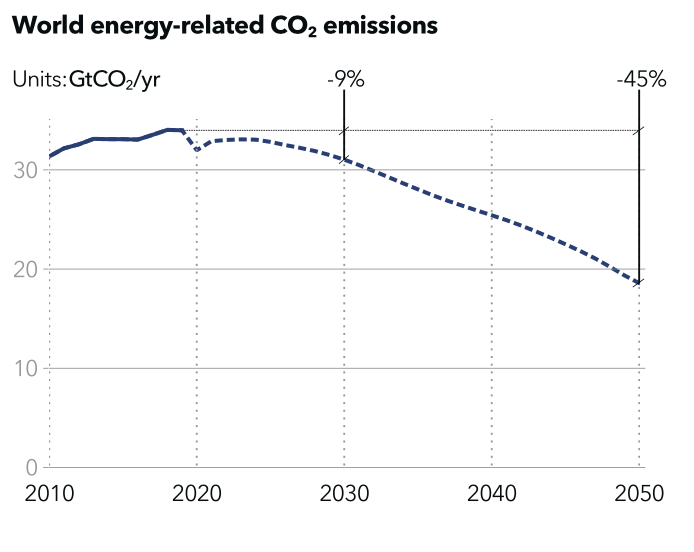
While they are being added at great speed, renewables currently often supplement rather than fully replace thermal power generation. By 2030, global energy-related CO2 emissions are likely to be only 9% lower than 2019 emissions, and by 2050 only 45% lower. This is in sharp contrast to ambitions to halve GHG emissions by 2030 and to achieve the net zero emissions by 2050 required to limit global warming to 1.5 ̊C. Our forecast is that we are most likely headed towards global warming of 2.3 ̊C by 2100.
As CO2 emissions continue to accumulate, the window of opportunity to act narrows every year. Relying on large- scale net-negative emissions technologies and carbon removal in the latter half of the century is a dangerous, high-risk approach. With global warming, every fraction of a degree is important, and all options to reduce emissions need urgent realization.
Electrification is surging ahead, and renewables will outcompete all other power sources
Electrification is by far the most dynamic element of the energy transition. The share of electricity in final global energy demand is set to double from 19% to 38% within the next 30 years.
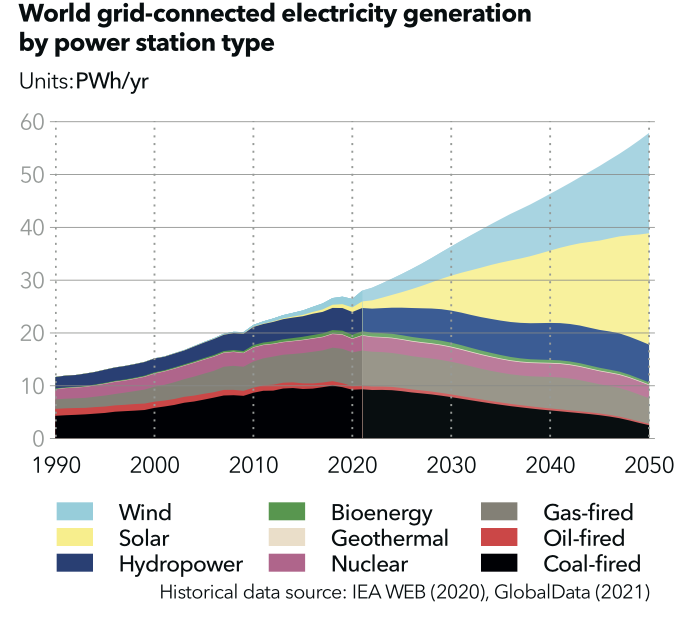
Solar PV and wind are already the cheapest form of new power almost everywhere, and within a decade will also be cheaper than operating existing thermal power in most places. By 2050, solar and wind will represent 69% of grid-connected power generation, and fossil power just 13%. Connectivity, storage and demand-response will be critical assets in the decarbonized power system.
On the demand side, passenger and commercial EV uptake is rising quickly in Europe, China and to some extent the US. Government incentives, cost reductions and technology improvements in both batteries and charging infrastructure will drive a rapid expansion.
By 2032, half of all new passenger vehicles sold globally will be electric, with some regions lagging owing to infrastructure challenges. In buildings, heat pumps use will triple, providing 42% of space heat in 2050 while consuming only 15% of energy used for space heating.
Fossil fuels are gradually losing position, but retain a 50% share in 2050
Fossil fuels have held an 80% share of the global energy mix for decades. We forecast that, by mid-century, fossil fuels will decrease, but still hold a 50% share of the energy mix, testament to the inertia of fossil energy in an era of decarbonization.
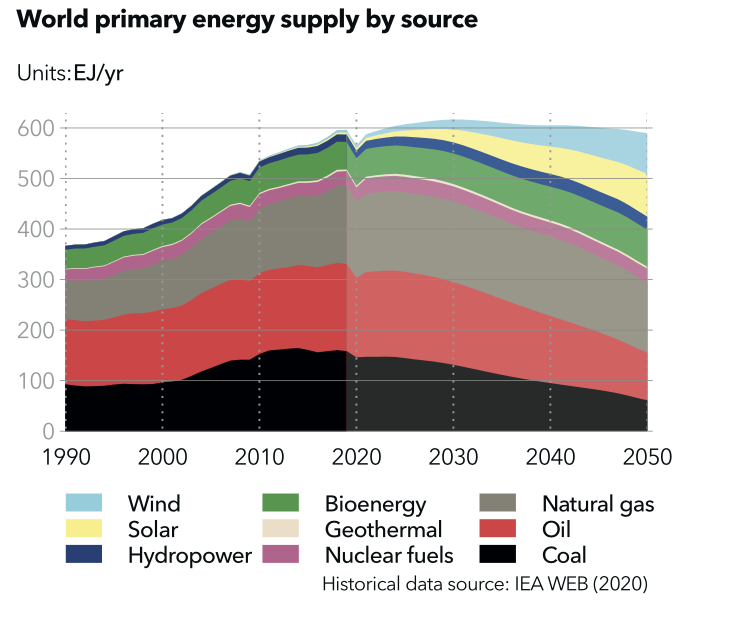
Coal use will fall fastest, down 62% by 2050. Oil use stays relatively flat until 2025 when it starts a steady decline, to just above half of current levels by mid-century. Gas use will grow over the coming decade, then levels off for a 15-year period before starting to reduce in the 2040s. Gas will surpass oil as the largest energy source and will represent 24% of global energy supply in 2050.
Decarbonized fossil energy is an important aspect of reaching the Paris Agreement, but the uptake of carbon capture and storage (CCS) is forecast to be woefully slow, mainly for reasons of cost, with just 3.6% of fossil CO2 emissions abated in 2050.
COVID-19 economic recovery spending is a lost opportunity
Government interventions, to stop the spread of the virus and then to restart activity, revealed how effective national and global actions can be. Similar action and funding have yet to be applied to the unfolding global climate crisis.
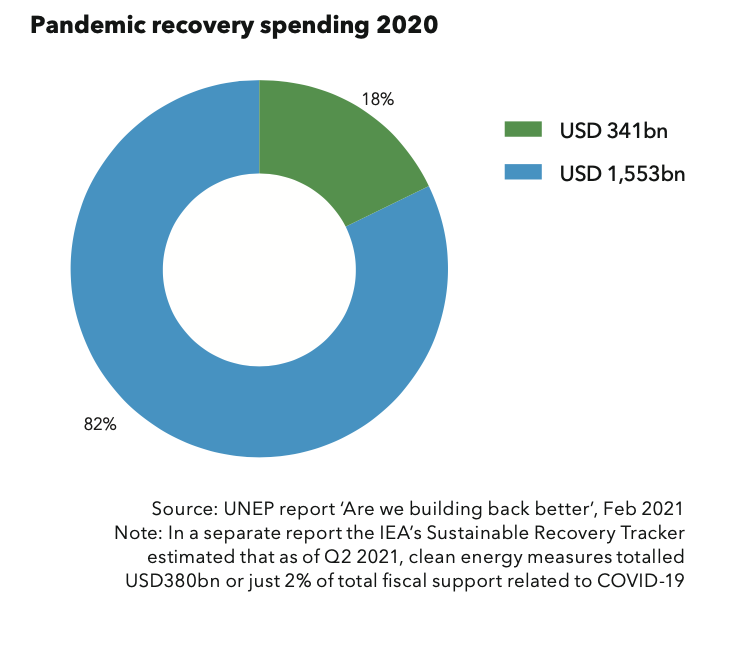
The trillion of dollars pushed into the global economy over the past 20 months have mainly been directed towards emergency measures like wage supplements and on building back the existing economic and indus- trial engine. Yet the opportunity for a green reset of production, transport and economic activity was unique, and as we wrote in ETO 2020, “The post-COVID-19 stimulus packages hold the potential to alter the speed of the transition.” With some notable exceptions, particularly in the EU, governments have not steered recovery spending towards a decarbonized outcome.
Global CO2 and GHG emissions fell 6% in 2020 but will rise again this year. While the emissions trajectory has shifted down slightly, that is due to lost economic activity, not energy-system renewal. The overall pace of the transition has not accelerated, and that is a lost opportunity