

Solar energy outlook 2021 from SolarPower Europe

Despite the severe impact of the COVID-19 pandemic across the world in 2020, the year still saw 138.2 GW of solar installed, representing an 18% growth compared to 2019, yet another global annual installation record for the solar PV sector. This brings the global cumulative solar capacity to 773.2 GW, a 22% increase, and marks a new milestone for the solar sector by exceeding three quarters of a terawatt.
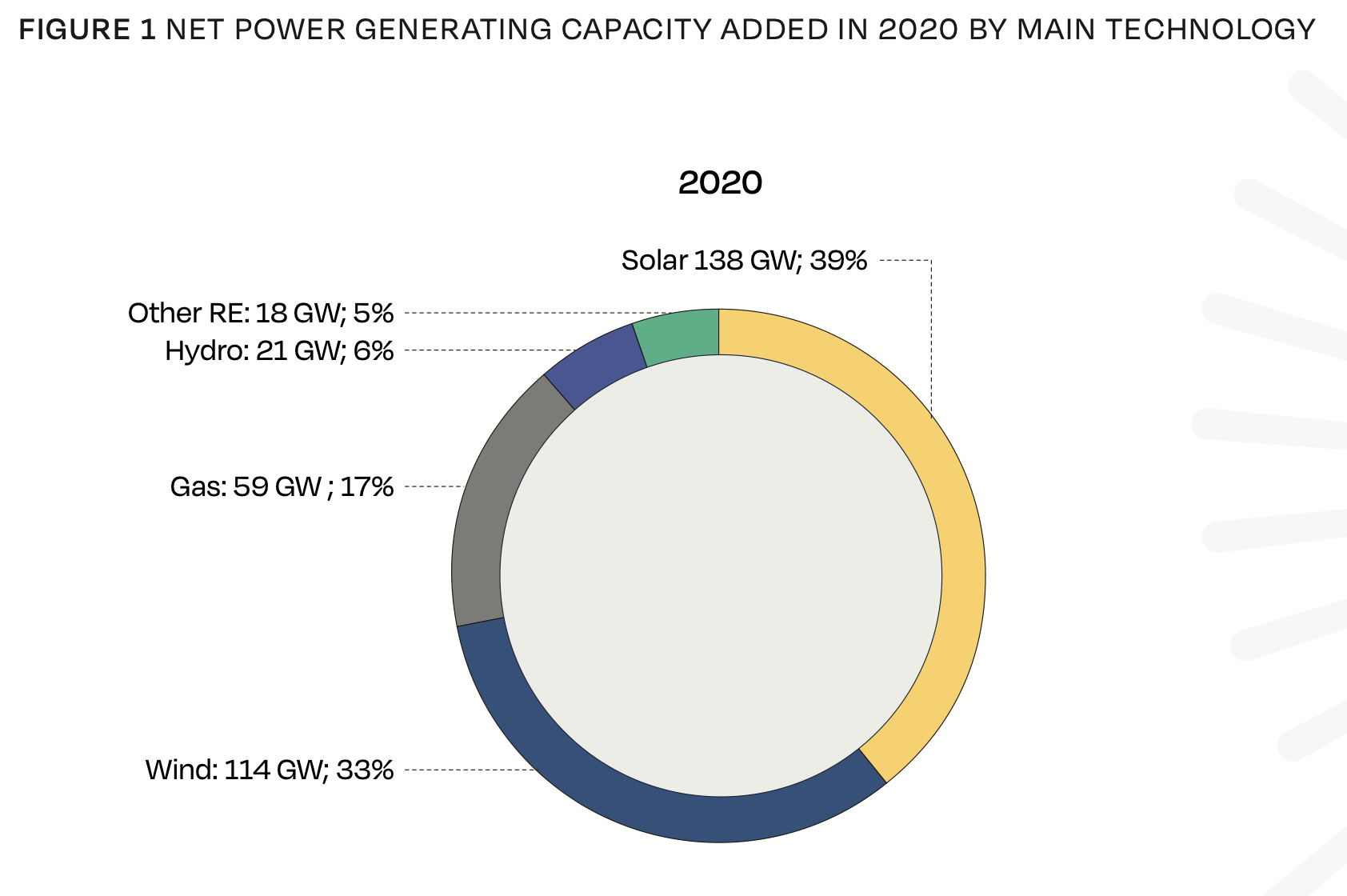
This surprisingly strong growth helped solar maintain its dominance among all newly installed power generating technologies, reaching a 39% global share, which translates into the impressive fact that more than every third power plant unit installed in 2020 came from solar. At the same time, solar’s total power generation share increased by 0.5 percentage points to around 3.1%, with nearly 70% still coming from fossil fuel and nuclear, highlighting the need to rapidly accelerate solar deployments.
Solar’s cost improved across the board for all segments with utility-scale solar now superior to fossil fuels in all unsubsidised investment cases, which also applies to solar + storage used to meet peak demand compared to gas peakers, according to investment bank Lazard.
The strength of solar could be observed in many tenders in 2020, where several winning bids in different geographical regions outperformed the record low of the previous year. At 1.32 USD cents, the 2020 global record bid in the second Portuguese auction was approximately 20% lower compared to the 2019 record, which was also achieved in Portugal.
The strong performance of China, growing by 60% to 48.2 GW, easily overcompensated for India’s losses in 2020, pushing up demand for solar in the Asia-Pacific region to a global share of 62%. While an exceptionally good year for solar in the United States carried the Americas to a higher share of 19%, Europe’s slower growth rate than the global average meant a market share reduction to 17%. Despite China’s market growth, the number of volume markets entering the GW-level has only marginally increased to 18 in 2020, up from 17 the year before.
In the first half of 2021, the solar sector was characterised by increasing costs for wafer, cell, and module manufacturers, primarily due to rising silicon prices because of a supply shortage. COVID-19 affected several major solar markets, in particular India. However, a Global Solar Council poll on the impacts of the pandemic on the solar sector showed an improving industry outlook, with 81% of respondents expecting sales to grow in 2021 compared to 72% in 2020. Despite the various price increases along the solar value chain and the continued negative impact of COVID-19 and its variants, solar will see another stellar growth year in 2021. SPE`s Medium Scenario anticipates newly installed capacities to increase by 18% to 163.2 GW.
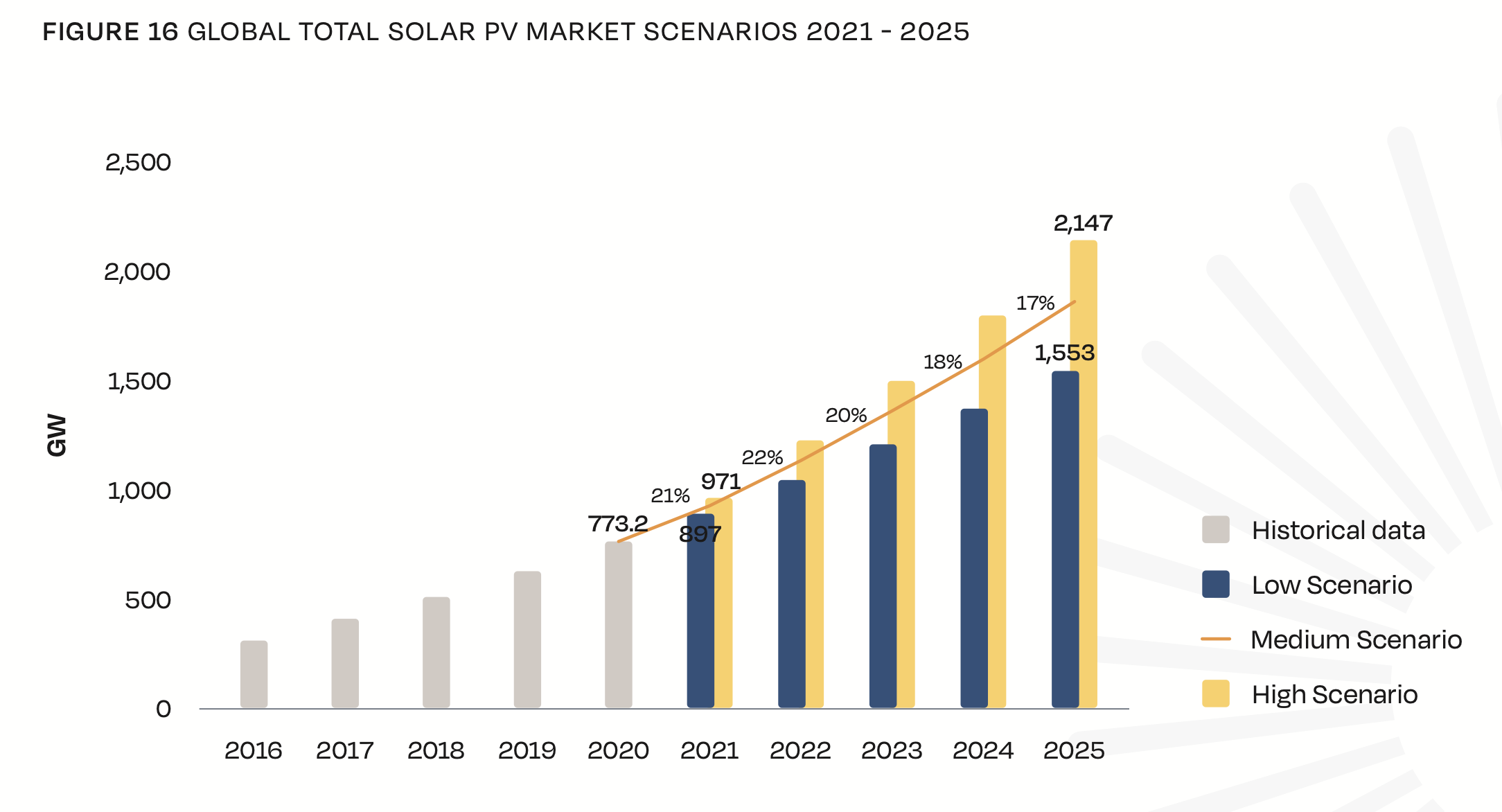
As vaccination rates reach necessary levels across the major solar markets, and with the silicon supply issue solved, the next four years are expected to be very strong for solar power around the world. For each year up to 2025, we have considerably increased our forecasts, but 2022 will stand out. In SPE`s Medium Scenario, we see the global solar market increase by 25% to 203 GW in 2022, the first time that annual PV installations will cross the 200 GW level, which we had previously expected to be accomplished only in 2024. With continued growth to annual additions of 266 GW in 2025, the operating global solar power generation portfolio will reach close to 1.9 TW, and in the most optimistic scenario even exceed the 2 TW level in four years’ time.