

IEA: Greater global effort is needed to reach net zero
Ahead of the COP26 conference beginning in Glasgow later this month, the International Energy Agency this week published its World Energy Outlook report for 2021. While it expects rapid growth in renewable energy, the report finds that, on top of currently stated policies, annual energy transition-related investments would need to reach US$4 trillion annually by 2030.
The International Energy Agency (IEA) published the latest edition of its annual World Energy Outlook report. The report finds that global progress toward clean energy is still too slow when measured against rising global average temperatures.
The report finds that based on currently stated policies, demand for all fossil fuels will begin to flatten in the 2030s and start to fall slightly by the 2050s. But this would still see the rise in global average temperatures surpass the 1.5 degrees Celsius mark around 2030 and hit 2.6 degrees by 2100.
With the next COP conference coming to Glasgow, Scotland, in a couple of weeks, the report aims to highlight “the need for an unmistakeable signal of ambition and action from governments in Glasgow.” The report finds that even if all pledges announced by governments are implemented in full, global oil consumption would still be more than 75 million barrels a day by 2050.
“The world’s hugely encouraging clean energy momentum is running up against the stubborn incumbency of fossil fuels in our energy systems,” said Fatih Birol, IEA Executive Director. “Governments need to resolve this at COP26 by giving a clear and unmistakeable signal that they are committed to rapidly scaling up the clean and resilient technologies of the future. The social and economic benefits of accelerating clean energy transitions are huge, and the costs of inaction are immense.”
In the report’s ‘Net zero emissions by 2050’ scenario, oil demand falls to 25 million barrels per day by 2050. This year marks the first time that all of the World Energy Outlook’s scenarios see demand for oil falling by 2050, from its current level of around 100 million barrels per day.

Increased investment
The report identifies four main areas as key to the solution here, firstly a massive push for electrification, and for clean energy to supply that electricity. And this should come alongside focus on energy efficiency, preventing leaks from ongoing fossil fuel operations, and a boost to clean energy innovation.
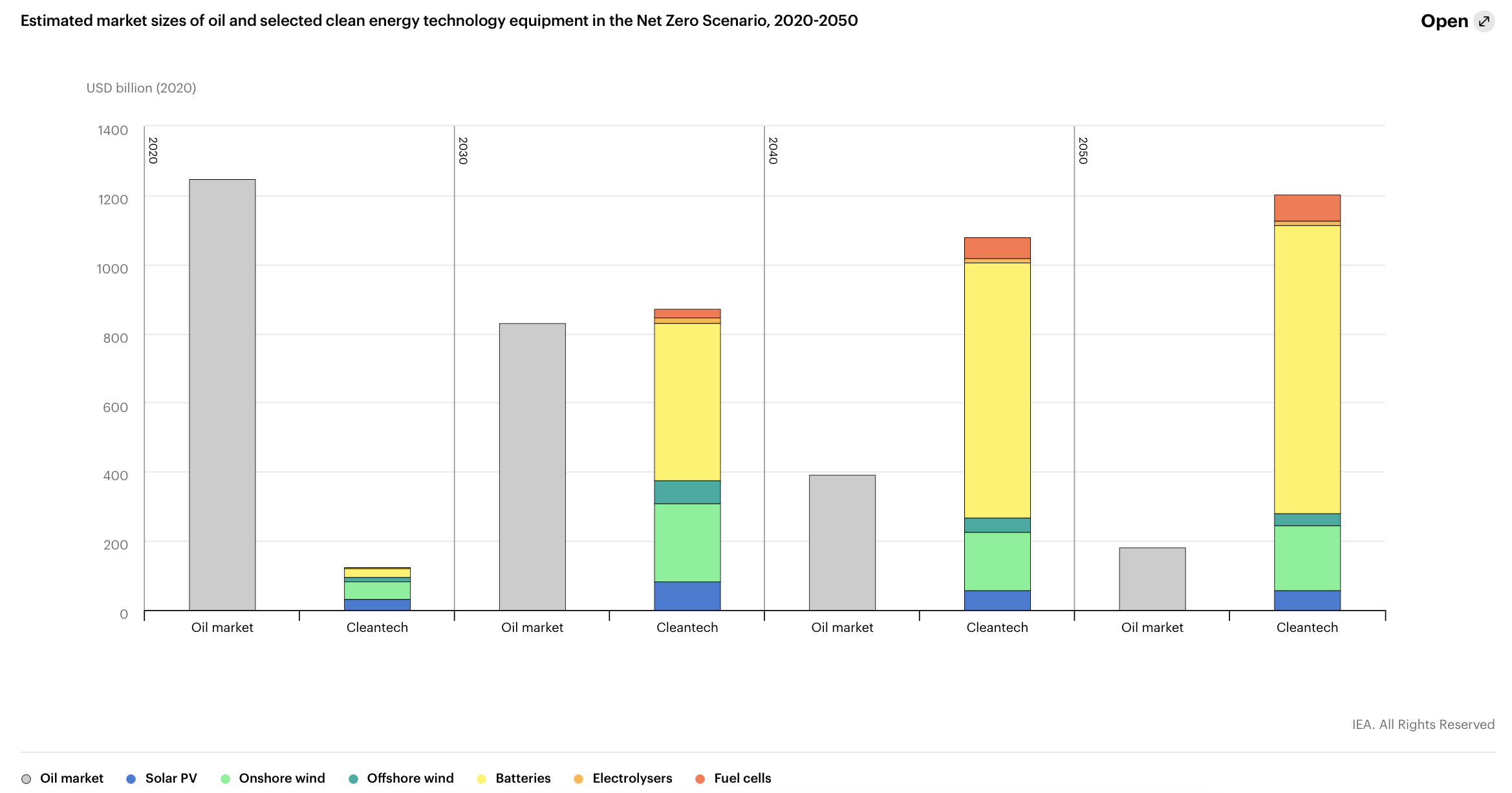
Key to all of these will be increased investments in the energy transition, which IEA estimates need to hit $4 trillion annually before 2030. “There is a looming risk of more turbulence for global energy markets,” Birol said. “We are not investing enough to meet for future energy needs, and the uncertainties are setting the stage for a volatile period ahead. The way to address this mismatch is clear – a major boost in clean energy investment, across all technologies and all markets. But this needs to happen quickly.”
These investments would create a market for key renewable energy technologies – wind turbines, solar panels, lithium-ion batteries, electrolysers and fuel cells, worth well over $1 trillion a year by 2050, comparable to the size of today’s oil market, according to IEA.